


When it comes to the world of stationery, a big capacity pencil case is a game - changer for students, artists, and professionals alike. As a supplier of high - quality big capacity pencil cases, I've been asked numerous times about the width of these essential items. In this blog, I'll delve into the factors that determine the width of a big capacity pencil case and provide some insights to help you understand this crucial dimension.
Understanding the Concept of Big Capacity
Before we discuss the width, it's important to define what a big capacity pencil case is. A big capacity pencil case is designed to hold a large number of writing instruments, such as pens, pencils, markers, and even small rulers or erasers. It offers multiple compartments and pockets to keep everything organized. This type of pencil case is ideal for those who need to carry a wide variety of stationery items with them, whether it's for school, work, or creative projects.
Factors Influencing the Width
1. Number of Compartments
One of the primary factors that affect the width of a big capacity pencil case is the number of compartments it has. A pencil case with more compartments will generally be wider because each compartment needs to have enough space to hold items without overcrowding. For example, a pencil case with three large compartments side - by - side will be wider than one with just a single large compartment. This is because the additional compartments add to the overall lateral space of the pencil case.
2. Size of Items to be Stored
The size of the items you plan to store in the pencil case also plays a significant role. If you need to store large markers or thick sketchbooks, the pencil case will need to be wider to accommodate them. On the other hand, if you mainly use standard - sized pens and pencils, a narrower pencil case may suffice. As a supplier, I've noticed that customers who are artists or designers often require wider pencil cases to store their larger art supplies, while students may be able to get by with a slightly narrower one.
3. Design and Style
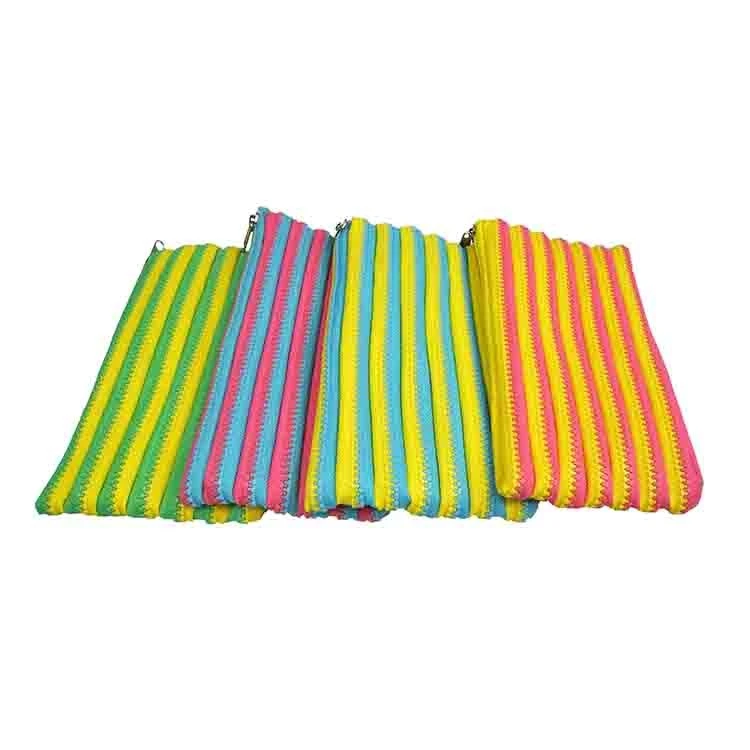
The design and style of the pencil case can impact its width. Some pencil cases are designed with a sleek and slim profile, even if they have a big capacity. These are often made with innovative storage solutions, such as accordion - style compartments or fold - out sections. In contrast, a more traditional box - shaped pencil case may be wider to provide a more straightforward and spacious storage area. For instance, a Nylone Mesh Pencil Case might have a different width compared to a Multi Functional Pencil Case due to their distinct designs.

Common Width Ranges
In the market, big capacity pencil cases typically have a width ranging from 3 inches to 8 inches. Pencil cases on the narrower end of the spectrum, around 3 - 4 inches, are suitable for those who only need to carry a moderate number of standard - sized items. They are often more portable and can easily fit into a backpack or purse.
On the other hand, wider pencil cases, around 6 - 8 inches, are great for storing a large quantity of items or larger - sized stationery. These are often preferred by students who have a lot of writing tools for different classes or by artists who need to carry a variety of art supplies. For example, a Daul Zipper Pencil Case might fall into the wider range if it is designed to hold a large number of markers and brushes.
Importance of Width in Functionality
The width of a big capacity pencil case is directly related to its functionality. A well - chosen width ensures that the items inside are organized and easily accessible. If a pencil case is too narrow, it may be difficult to fit all the necessary items, and they may become cramped and damaged. On the other hand, if it is too wide, it may take up unnecessary space in your bag and make it difficult to carry.
For example, if you're a student who needs to carry a lot of pens, pencils, and highlighters for different subjects, a pencil case with an appropriate width will allow you to separate your items by subject or type. This makes it easier to find what you need quickly during class. Similarly, for an artist, a wider pencil case can hold a variety of brushes and paints in an organized manner, preventing them from getting mixed up or damaged.
Customization of Width
As a supplier, I understand that different customers have different needs when it comes to the width of a big capacity pencil case. That's why we offer customization options. We can work with you to create a pencil case with the exact width you require based on your specific storage needs. Whether you need a very narrow pencil case for a minimalist setup or a wide one for storing a large collection of art supplies, we can accommodate your requests.
Choosing the Right Width for You
When choosing the width of a big capacity pencil case, consider your specific needs. Think about the number and size of the items you need to store, as well as how you plan to carry the pencil case. If you're always on the go and need to fit the pencil case into a small backpack or purse, a narrower option may be more suitable. However, if you have a lot of items to store and don't mind a larger - sized pencil case, a wider one will be a better choice.
Conclusion
In conclusion, the width of a big capacity pencil case is a crucial factor that is influenced by various elements such as the number of compartments, the size of items to be stored, and the design and style. Understanding these factors can help you choose the right width for your needs. As a supplier, we are committed to providing high - quality big capacity pencil cases with a range of width options to meet the diverse requirements of our customers.
If you're interested in purchasing our big capacity pencil cases or have any questions about the width or customization options, we encourage you to contact us for a procurement discussion. We look forward to working with you to find the perfect pencil case solution for your needs.
References
- Stationery Industry Reports on Pencil Case Design and Dimensions
- Customer Surveys on Pencil Case Usage and Preferences


